
TL;DR: A strong business plan needs eight sections and one thing above all: data you can defend. That means TAM, SAM, and SOM figures traced to named sources, IBISWorld, U.S. Census Bureau, BLS, or BEA, not AI-generated estimates with no audit trail. Investors challenge numbers. Your plan should be ready for that.
Startup Market Research: How to Write an Investor-Ready Business Plan
What Makes a Business Plan Investor-Ready?
Startup market research is the foundation of every investor-ready business plan. A plan defines your business, proves its viability, and guides every major decision from launch through growth. Every section has a job. Skip one and you lose credibility with the people writing the check. Most founders treat the plan as a box to check. That produces thin documents that fall apart when an investor asks a follow-up question. A defensible plan is a working tool, not a formality. This guide covers each of the eight core sections. It explains what belongs in each one and how to source the market data and financial benchmarks that make your numbers holdable.
- Cover executive summary, market research, financials, and operations.
- Back every projection with a citable source.
- Revisit the plan every 6 to 12 months as your business evolves.
Why Do Investors Reject Business Plans?
Investors reject plans for a short list of reasons. The market size number has no source. The financials look like guesses. The founder cannot say where the data came from. A business plan forces you to stress-test your idea before real money is on the line. It shows investors, banks, and partners that you understand your market, your numbers, and your risks. About 20% of small businesses close within their first year, according to U.S. Bureau of Labor Statistics data. Most of those closures trace back to problems a solid plan would have caught: weak demand, mispriced offers, or cash flow gaps. “If you don’t understand the details of your business, you’re going to fail.” — Jeff Bezos, Amazon founder
Three specific things a business plan does for you:
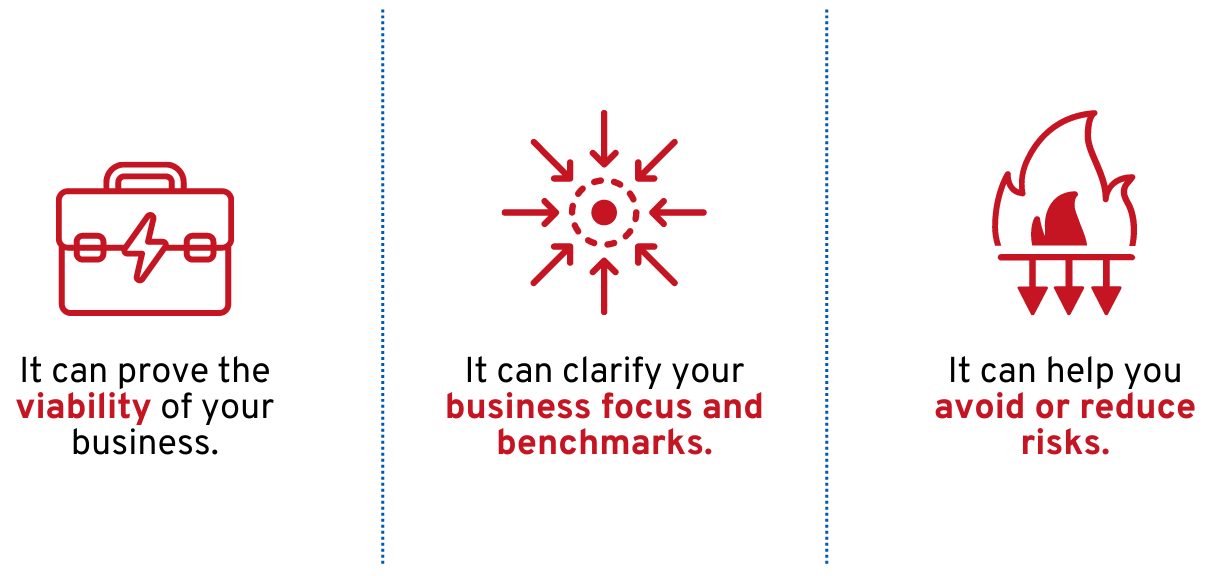
- Proves the viability of your business. A business plan helps establish how realistic your concept, goals, and projections are. It should convince your reader — the bank, investors, other lenders — to be involved and fund your business. Market research on your target customers, competitors, and industry is critical in timing the introduction of your business and how you decide to do so through marketing and advertising.
- Forces clarity on pricing, positioning, and the competitive landscape before you spend money. Writing your vision for every aspect of your business will help you make critical decisions about financial, management, HR, IT, competitor, and customer issues.
- Helps you avoid or reduce risks. Researching your market and competitive landscape, as well as making revenue and expense projections, can help you prepare for potential risks and challenges.
How Long Should a Business Plan Be?
There is no single right length. The right length is the one your audience needs. For a new company still testing its concept, 10 to 15 pages is enough. It gets you to internal alignment without over-engineering a plan that will change. If you are approaching a bank or equity investors, plan to go longer. More capital means more risk on their side, and more detail required on yours. An operational plan used internally sits somewhere between the two. Regardless of length, every plan should include the eight sections below.
1. Executive Summary: Make the First Page Count
The executive summary is a one-to-two page overview of your entire plan. Most investors read this first, and stop here if it does not earn the next page. Cover your business concept, the problem you solve, your target market, your revenue model, and how much capital you need. Keep it tight. Every sentence should make the reader want to continue.
Key tips:
- Write this section last: Once every other section is complete, you will have the material you need to summarize accurately. Writing it first almost always means rewriting it later.
- Keep it to one or two pages: Investors often read the executive summary before deciding whether to read the rest, so every sentence needs to carry weight.
2. Company Description: Who You Are on Paper
The company description gives readers the full picture of your business. Include your registered business name, physical location, legal structure, sole proprietorship, partnership, or corporation, founding history, and the people running the operation. This section is not a brand story. It is a legal and operational snapshot. Investors use it to verify that the entity behind the plan is real and structured correctly.
Key tips:
- List key team members alongside their relevant skills and experience. Investors back people as much as ideas, so this section matters more than most founders expect!
- Be honest about your weaknesses here, and explain your plan to address them. Transparency builds credibility.
3. Products or Services: What You Sell and Why It Matters
Describe what you sell and the specific problem it solves. Be concrete about your pricing strategy, the product or service lifespan, and the benefit to your target customer. Avoid vague language like ‘innovative solution’ or ‘first of its kind.’ Name the problem. Name the customer. Explain how your offer removes a friction that exists today.
Key tips:
- If you are in an early stage, describe where the product is in development and what the path to market looks like. If you are already selling, include early traction, customer feedback, or retention data.
- Position your offer clearly against existing alternatives. Investors want to know why customers would choose you.
4. Market Research: Where Your Numbers Have to Hold Up
This is the section investors scrutinize most. A weak market research section signals one of two things: the founder does not know the market, or the founder does and is hiding it. Your market research section should answer three questions:
- How large is the total addressable market (TAM), and what sources confirm that number? Learn how to calculate TAM, SAM, and SOM using primary data sources.
- Who is your target customer, and what data describes their behavior?
- How does your product differ from what is already available?
For sources, start with free government data: the U.S. Census Bureau, the Bureau of Labor Statistics (BLS), and the Bureau of Economic Analysis (BEA). For industry-specific figures, licensed platforms like IBISWorld publish data you can cite by name. Intellihance pulls from these licensed sources and structures the output into plan-ready sections, so you get cited market data without building from scratch.
Key tips:
- Use government sources like the U.S. Census Bureau and Bureau of Labor Statistics alongside licensed platforms such as IBISWorld and Statista. Conduct original customer interviews or surveys to add primary research that no competitor can replicate. Intelligence from licensed datasets helps you benchmark pricing and positioning against real market data, not assumptions.
- Define your ideal customer profile here: demographics, behaviors, needs, and buying triggers. Then show how your offer is positioned differently from what already exists in the market.
Also, in this section, describe your ideal customer or customer profile, as well as how your product or service differs from those already in the market.
5. Marketing and Sales Strategy: How You Will Reach Customers
Your marketing and sales section explains how you will reach customers and convert them. Cover both digital and traditional channels, plus any partnerships that accelerate distribution. For product businesses, detail your distribution channels, logistics costs, and supply chain risks. For service businesses, walk through your sales process from first contact to signed contract. The best test of this section: could someone execute your GTM plan from what you have written? If not, add specificity. Consider whether your market validation before your pitch is strong enough to support the claims in this section.
Key tips:
- Show your pricing model and how it compares to competitors. Competitive intelligence from licensed datasets gives your pricing section a factual foundation that will hold up in investor conversations.
6. Financial Plan: Where Most Plans Lose Investor Confidence
The financial plan is where most business plans fail. Projections without credible sourcing look like guesswork, and investors treat them that way. Your financial plan should include:
- A 12-month sales and revenue forecast
- A three-to-five-year annual projection
- A cash flow statement
- A profit and loss statement
- A balance sheet
Every projection needs a source. If your revenue assumption is based on an industry average, name the industry average and where it came from. If your cost assumptions are based on benchmarks, cite them. Projections tied to named sources are defensible. Everything else is a guess.
Key Tips:
- Source every projection to a named benchmark. The Bureau of Labor Statistics (BLS), Bureau of Economic Analysis (BEA), and IBISWorld provide the kind of defensible figures that survive due diligence. If a number cannot be traced to a named source, it should not be in the plan.
7. Operational Plan: What It Actually Takes to Deliver
The operational plan describes how your business runs day to day. Cover facilities, equipment, technology, inventory management, and your production or service delivery process. For manufacturers, include processing protocols, quality controls, and compliance requirements. For service or software businesses, cover team structure, tools, and delivery workflows. List key vendors and staffing needs here as well. Investors and lenders want to see that you have thought through execution, not just the idea.
8. Funding Requirements: Tell Investors Exactly What You Need
If you are raising capital, this section tells lenders and investors what you need and how you will use it. Be specific. Vague asks read as unprepared founders. State the total capital required, the period it covers, and a line-item breakdown of how the funds will be deployed. Include your preferred repayment terms if applicable. For bank loans, name the loan type and identify any collateral. The more specific the ask, the more credible it reads.
How to Make Your Business Plan Stand Out
A plan that stands out is not longer, it is more specific. Vague claims lose readers. Specific, cited claims build trust. Three things separate plans that get funded from ones that do not:
- Every market size claim has a named source
- Financial projections are tied to benchmarks, not estimates
- The customer profile is concrete enough to be a real person, not a demographic range
Treat your plan as a living document. Start with what you know. Expand it as your business grows. A two-page plan with solid sourcing beats a 40-page plan full of unsupported projections.
Additional tips:
- Start your plan with market research. Before you write a single section, gather your data. Research shapes your product positioning, pricing, and go-to-market strategy. Sections written without it tend to read as vague.
- Determine the legal structure of your business early. Your choice between sole proprietorship, partnership, and corporation affects owner taxation and stakeholder liability throughout the entire document.
- Write the executive summary last. You cannot accurately summarize a plan you have not finished yet.
- Get your team’s input before you finalize. Colleagues spot gaps in logic and unanswered questions that the writer often misses. A professional writer can also tighten the language before it goes to a bank or investor.
- Cite every number before the plan leaves your hands. Figures sourced to ‘research suggests,’ or an unnamed report, will not survive investor scrutiny. If you cannot trace a number to IBISWorld, BLS, BEA, or the U.S. Census Bureau, replace or verify it.
- Treat it as a living document. Revisit your plan every 6 to 12 months. Markets shift, costs change, and a plan that reflected reality at launch may need a full update within a year.
Frequently Asked Questions About Writing a Business Plan
What is the most important section of a business plan?
The financial plan and the market research section carry the most weight with lenders and investors. Financials show viability. Market research shows you understand the opportunity. Neither works without credible sourcing.
How often should I update my business plan?
Review and update your plan every 6 to 12 months, or any time there is a significant shift in your market, team, or product direction. A plan that no longer reflects your business can mislead the people relying on it.
Do I need a business plan if I am not raising money?
Yes. A business plan forces you to clarify your goals, validate your assumptions, and set benchmarks for measuring progress. Founders who skip it often discover avoidable problems only after spending real money.
How do I find reliable data for my business plan?
Start with free government sources: the U.S. Census Bureau, the Bureau of Labor Statistics, and the Bureau of Economic Analysis. For industry-specific figures, licensed platforms like IBISWorld provide data you can cite by name. Intellihance pulls from these sources and structures the output into plan-ready sections, so you get investor-ready market analysis built on IBISWorld, U.S. Census Bureau, BLS, and BEA, not AI inference.
Your Business Plan Is Only as Strong as the Data Behind It
Every projection you cannot source is a risk you are asking your reader to absorb on faith. Experienced investors and lenders rarely do that. Intellihance, an AI market research platform, pulls from licensed industry databases and government sources, IBISWorld, the U.S. Census Bureau, BLS, and BEA. It structures the output into plan-ready sections and gives you the citations you need before the plan goes out the door. If you are building or updating a business plan now, start your free 14-day trial of Intellihance to get the market intelligence and financial benchmarks that make your plan defensible.